what do ‘white guys’ think about race? this professor is trying to find out
When I posted news of my "Censoring Children'due south Literature" form last month, several people (well, OK, 1 person …maybe two) expressed an interest in hearing more about the course. So, given that Banned Books Calendar week is coming up next week, here's an update. Having lately been examining 2 versions of Hugh Lofting's Doctor Dolittle (1920, 1988) and iii versions of Roald Dahl's Charlie and the Chocolate Mill (1964, 1973, 1998), we've been addressing this question: Do Bowdlerized texts alter the ideological assumptions of the original? The reply is more complicated than you might retrieve.
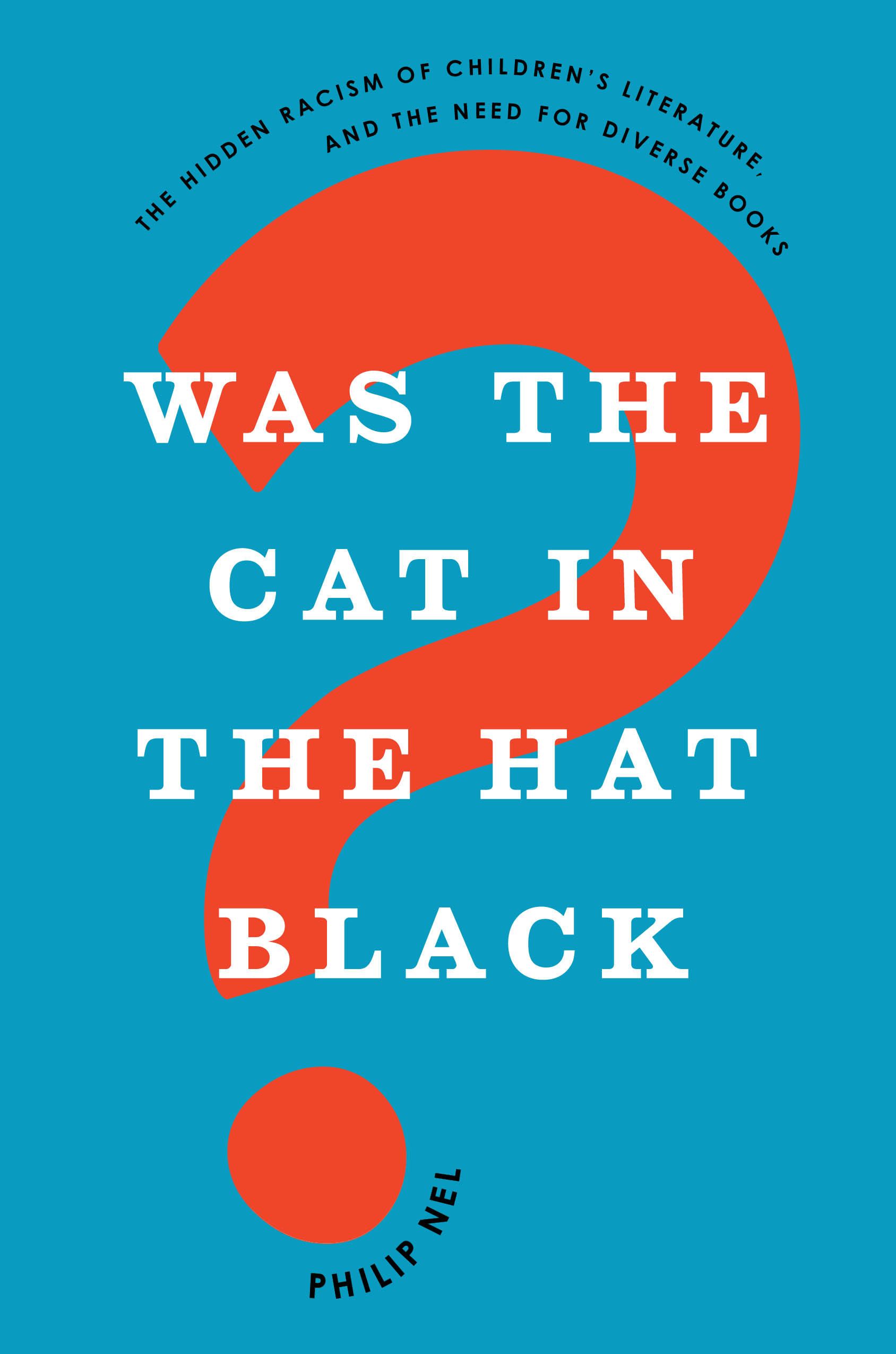 NOTE . Delight see my revised, substantially expanded,Âbetter inquiry into this subject field – Affiliate 2 ("How to Read Uncomfortably: Racism, Affect, and Classic Children's Books") ofÂWas the Cat in the Hat Black?: The Subconscious Racism of Children's Literature and the Need for Diverse Books (Oxford Upwards, 2017), pp. 67-106.
One could make a case for "yeah, they practice alter the ideological assumptions of the original." The 1988 edition of Md Dolittle removes all references to skin color: "black man" becomes "homo," and "white man" becomes "man" or "strange man." Instead of tricking Prince Bumpo past preying on his desire to be white (in the original), Polynesia tricks Prince Bumpo past hypnotizing him (in the current version). In the 1973 edition of Charlie and the Chocolate Mill, the Oompa-Loompas are no longer African Pygmies – they're from Loompaland.  Illustrator Joseph Schindelman changes their colors from black to white, and current illustrator Quentin Blake keeps them white in his 1998 edition. Inasmuch as Willy Wonka's workers are human being beings imported from another country, the whitened Oompa-Loompas remove the original book'due south implication that a person of European descent had enslaved people of African descent, and that the latter group had gladly accepted their new lot as his slaves. Similarly, inasmuch the colonialist impulses of Doctor Dolittle are now no longer so explicitly attached to skin color, the 1988 edition diminishes the overt racism of the original edition. The King of the Jolliginki may withal throw childish temper tantrums and Prince Bumpo nevertheless may be easily duped, merely in the new edition they're just colour-less victims of Lofting's satire.
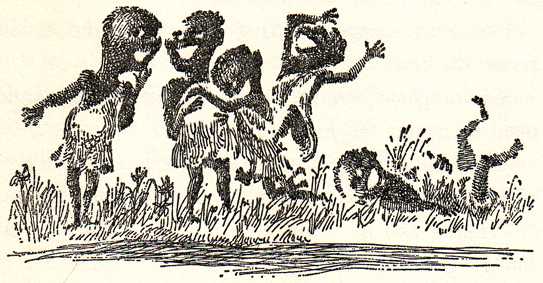
The Oompa-Loompas, as illustrated past Joseph Schindelman, 1964
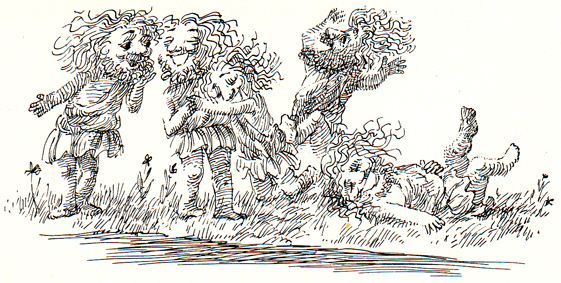
The Oompa-Loompas, every bit illustrated by Joseph Schindelman, 1973
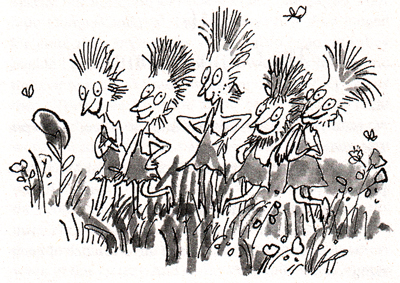
The Oompa-Loompas, every bit illustrated by Quentin Blake, 1998
One could likewise make a instance for "no, they practise not alter the ideological assumptions of the original," challenge that the new versions instead more subtly encode the same racial and colonial messages of the original versions. After all, the Oompa-Loompas nonetheless live in "thick jungles infested by the most dangerous beasts in the entire earth," and are even so a "tribe" who do not learn English language until they come up to Great britain. Even though the animals are now nonsensical ("hornswogglers and snozzwangers and those terrible wicked whangdoodles"), information technology's not unreasonable for a child to assume that a "tribe" living in "thick jungles" are Africans living in Africa. And they still happily acquiesce to being shipped to England "in big packing cases with holes in them," and observe life in a factory preferable to life in their native state. Though I don't hold with all of Eleanor Cameron's 1972 critique, the 1973 and 1998 versions of Charlie and the Chocolate Manufactory exercise not fundamentally contradict her concerns about "Willy Wonka's unfeeling attitude toward the Oompa-Loompas, their role as conveniences and devices to be used for Wonka's purposes, their beingness brought over from Africa for enforced servitude, and the fact that their situation is all a part of the fun and games."
Similarly, while the 1988 edition of Doctor Dolittle makes an effort to make race invisible, information technology does not make the original book's colonial ideologies vanish. Though at present from "the Country of the Europeans" instead of "the Land of the White Men," Dr. Dolittle is an enlightened white European who goes to civilize the natives. The Rex of the Jolliginki may now be colorless, but he still lives in a palace "fabricated of mud" in the jungle, and is foolish plenty to be duped by a bird (Polynesia). Both he and his men are decumbent to childlike tantrums, which (even sans color) invokes the stereotype of Africans as childlike. And the monkeys still stand in for indigenous people. They are ill considering of lack of proper sanitation (flies infect their nutrient supply), and they have no history: "the monkeys had no history books of their ain earlier Doctor Dolittle came to write them for them, they remember everything that happens past telling stories to their children." Removing pare colour from the text and illustrations does not necessarily remove colonialism. As New York librarian Isabelle Suhl wrote of the Doctor Dolittle series in 1968, "These attitudes permeate the books … and are reflected in the plots and deportment of the stories, in the characterizations of both animals and people too as in the language that the characters apply. Editing out a few racial epithets will not, in my view, make the books less antipathetic."
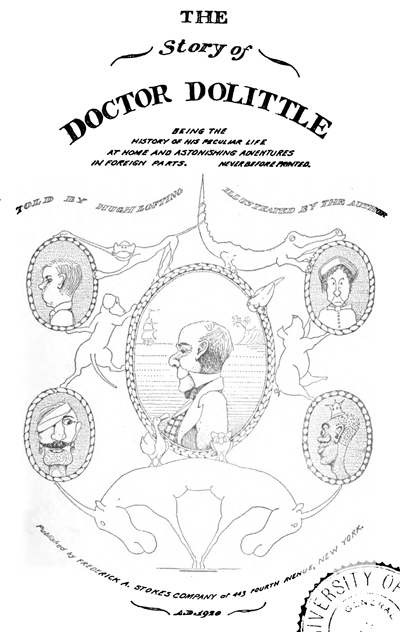 frontispiece,ÂThe Story of Doc Dolittle, illustrated past Hugh Lofting, 1920 | 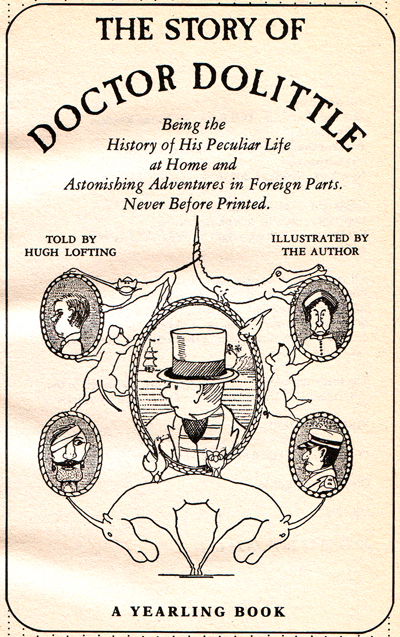 frontispiece,ÂThe Story of Doctor Dolittle, illustrated by Hugh Lofting, 1988 |
So, then. What exercise y'all do with these books? If you're persuaded past the idea that de-colorizing the books also removes credo, then you tin with clear conscience read the new versions to immature people and encourage young people to read them. Later on all, Dahl himself revised Charlie and the Chocolate Factory, and in so doing replaced Africa with the pleasantly nonsensical Loompaland. And Doctor Dolittle's kindness towards animals has inspired many advocates of fauna rights. The 1988 edition uses the words of one such person, Jane Goodall, as a blurb on the back of the book: "Whatever kid who is not given the opportunity to brand the associate of this rotund, kindly, and enthusiastic md/naturalist and all of his fauna friends will miss out on something of import." Along side of whatsoever troubling ideas, the Dolittle books incorporate much that may delight and instruct.
Yet, if you're concerned that the books simply dress upward racial and colonial ideologies in different costumes, then you face a choice: (1) Discourage children from reading them, (two) Permit children to read only the Bowdlerized versions, (3) Allow children to read whatever version, original or Bowdlerized.
(1) Discussing revised editions of her own works, Anne Fine asks, "Which is the real version? Who's to say? The originals are the ones I would save from a fire. I rather hope the newer versions are the ones my readers would have with them to desert islands." I think what she ways by this is that she hopes people re-read the revised editions, but thinks the originals should be preserved for posterity. In Should We Burn down Babar?, Herbert Kohl uses a similar logic: "I wouldn't ban or burn Babar, or pull it from libraries. But buy information technology? No. I see no reason to go out of one's way to brand Babar bachelor to children, primarily considering I don't run across much critical reading going on in the schools and children don't need to be propagandized most colonialism, sexism, or racism." So, and so, nosotros might relegate Charlie and the Chocolate Mill and Doctor Dolittle – whether original or revised – to the status of cultural artifact, historically significant but no longer read.
One trouble with this arroyo is that it acts as a kind of covert censorship, a blacklist of sorts. Information technology says: "oh, no, we're not banning the book. We're just not inviting it." And so, if you're of a libertarian mindset, this response will non suffice.
(2) What well-nigh allowing children to read just the Bowdlerized versions, then? That might (in some measure) appease the person of libertarian leanings who nonetheless does not wish to collude in the replication of harmful ideologies. Yep, information technology might… if you believe that the Bowdlerized versions exercise – as Lori Mack, editor of the 1988 version of Md Dolittle, said of that volume – "preserve Hugh Lofting'due south style and spirit" but without "the offensive caricature." Yet, if you're a literary purist who believes in granting access to the original work or if you worry that these versions offer but a more subtle, insidious kind of propagandizing, then this arroyo will fail.
Just will it? Books containing stereotypes (whether re-costumed or not) invite children to participate in that way of thinking, but children do not have to accept the invitation. They may resist. If a volume'south presentation of people of color does non adjust to other images of people of color, then a child may dismiss the volume every bit dissonant. As an outlier, it perhaps does not unconsciously shape their perceptions.
(iii) If you believe in the kid's potential to resist, then yous might debate for granting admission to the original work on the grounds that the egregiousness of the original's stereotypes volition serve equally a kind of "alarm flag." In other words, 1 might argue that edgeless offensiveness is less harmful than a subtler delivery of prejudices considering the reader is more likely to pass up the former. We tin can read a volume and disagree with the volume; encountering a book with racist imagery might be more likely to provoke our censure. Encountering a book in which that imagery has been cleaned up (even while leaving other underlying assumptions intact) might exist less probable to provoke our censure. In sum, we could brand the example that unvarnished prejudice serves equally a better teaching tool.
One problem of this approach, however, is the disproportional burden it places on members of the stereotyped group. The white kid (for instance) who encounters Prince Bumpo or an Oompa-Loompa has the unearned privilege of not seeing people of her or his ethnicity being stereotyped. The African-American child (for example) does not have that privilege. This is not to say that prejudice lacks whatever ill consequences for the dominant grouping – a white kid learning that he or she is more important, more than key, can teach that child that dominating children (or adults) of color is acceptable behavior. Rather, this is to say that prejudice harms different groups in dissimilar means.
What, and so, is the solution? I'd exist the get-go to acknowledge that there is no ideal solution. One could argue, for example, that a "colorless" Doctor Dolittle rightly highlights the fact that race is a fiction: black, white, beige, yellow, etc. are pure fantasy. We're all members of the human race. On the other hand, 1 could counter that claim past noting that while race may be imaginary, people human activity on racial distinctions equally if they were real: denying the social fact of race is a course of lying.
As an educator, I'm inclined to fall dorsum on the (admitting imperfect) solution of reading troubling texts with young people, and talking with them most what they run into. As Herb Kohl writes, "It is not developmentally inevitable that children will learn how to evaluate with sensitivity and intelligence what the adult world presents them. It is our responsibility, as critical and sensitive adults, to nurture the evolution of this sensibility in our children." Further, he notes, critical reading can be a source of both pleasure and power: "children speedily come to understand that critical sensibility strengthens them. It allows them to stand up their basis …. It is a source of pleasure of well – of the joy that comes from feeling that one is living according to conviction and understanding."
Equally a negative state, innocence cannot be sustained indefinitely. As they grow upwardly, children will gain experience and knowledge. Some of those experiences volition hurt; some of that noesis volition make them sad. If we exclude troubling works from the word, and so children are more likely to face sadness and pain on their own. It is, I call back, improve that nosotros requite them the tools with which to face prejudice-bearing literature. In doing so, we tin can help them learn to cope with a world that tin can be neither only nor off-white. With this knowledge, perhaps nosotros may as well give them a source of power.
Source: https://philnel.com/2010/09/19/censoring-ideology/

Post a Comment for "what do ‘white guys’ think about race? this professor is trying to find out"